


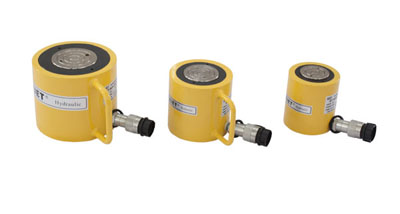
Thin jacks are increasingly used in electric power, metallurgy, construction, shipbuilding and other industries due to their small size. Among them, the most common tonnage is mainly 50 tons, 100 tons, this tonnage of thin jacks is enough for mechanical maintenance, even if we encounter greater load needs, we can use large tonnage jacks as a substitute. It is currently present throughout our industrial production processes.
structure
The thin jack is first of all a kind of separate jack, which is generally a single-acting structure, and can also be a double-acting design if there are special needs. Let me talk about the single-acting structure we usually use.
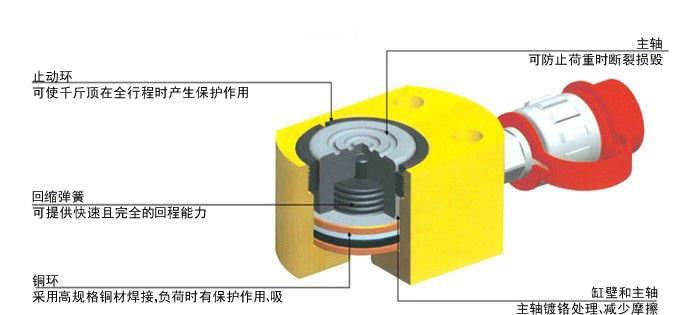
The thin jack requires a low body height, and the design scheme adopts a one-piece cylinder block, and the cylinder wall and piston wall are plated with hard chrome, which greatly enhances the strength of the cylinder block, and can be well protected from damage even if there is a collision during use. The bottom of the cylinder block adopts the overlapping arrangement of sealing rings and copper rings, and the high-specification copper welding effectively absorbs the corresponding lateral force. The main spring design of single-acting design, high-strength spring, can provide fast and complete return capability. A stop ring is installed on the top of the cylinder block to effectively prevent the piston from over-traveling.
Occasions
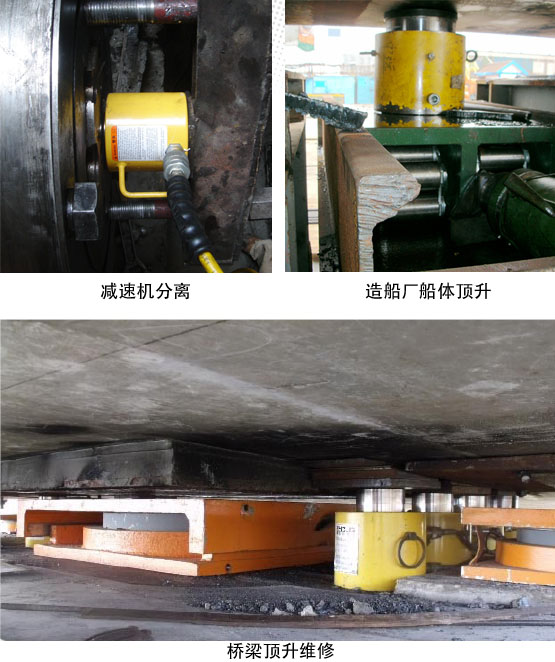
Thin and thin jacks are widely used in bridge maintenance, synchronous jacking and replacement of rubber bearings, synchronous jacking maintenance of large equipment, welding and positioning of structural parts, assembly of equipment, separation of pipeline flanges and other applications, spring return design, suitable for places where the minimum jacking height and maximum stroke are the primary factors. The most common use cases are listed below.
Machinery manufacturing enterprises: jacking and adjustment of large equipment
Bridge maintenance enterprises: bridge maintenance synchronous jacking bearing replacement, for example: intelligent control synchronous jacking hydraulic system for Haikou interchange box girder structure bearing replacement.
Construction enterprises: the overall jacking and translation of the building
Shipyard: hull welding overall jacking, shipyard main engine adjustment
Petrochemical enterprises: oilfield production machine maintenance
Cement plant: Roller press and reducer maintenance are separated synchronously. The ultra-thin hydraulic jack is used for the synchronous separation of the roller press and the reducer
advantage
Thin jacks are smaller in size and can produce greater working capacity, especially in places where space is narrow, and have the functions of lightness and flexibility, high lifting force, etc. High-strength special steel, one-piece cylinder block, no cylinder cracking phenomenon in use.
Separate structure, only one tubing is required, the length of the tubing can be controlled, away from the construction site, safe operation. Simple, lightweight, and easy to carry, compared with other lifting and lifting equipment, the thin jack with hydraulic drive is more suitable for work that requires irregular maintenance. The most common here is the 50-ton thin jack, which fully meets the needs of different working conditions due to the large number of similar models, and even plays an irreplaceable role in jacking, stretching, bending, and support operations.
How to use
Through the above description, we know the advantages of thin jacks, and below we will introduce how to use it better.
When a single thin jack lifts heavy objects, it is necessary to choose a thin jack with equivalent bearing capacity: the bearing capacity should not exceed the maximum limit, and a thin jack with a bearing capacity greater than 1.2 times the gravity of the heavy object should be chosen.
When multiple thin jacks are used together, the same type of thin jack should be selected, and the rated bearing capacity of each point shall not be less than 1.5 times the tonnage of the lifted heavy object.
Choose a low-profile jack with the lowest height: One measure is that the reserved space at the bottom of the weight should be greater than the minimum height of the low-profile jack, and it can ensure that the height of the piston rod of the thin jack is greater than the thickness of the pad (including the height after deformation) during the jacking process.
To keep the thin jack clean, do not contact corrosive liquids, and check whether the parts are flexible and damaged after long-term storage. During use, it is also necessary to ensure that all parts of the thin jack are in place smoothly and should not be unplugged and unplugged hastily.
Before use, ensure that the bottom of the thin jack is flat, so that the bottom surface and the contact surface are on the same plane, and ensure that the contact surface is strong and slipper-resistant. Let the center of gravity of the jacking bear and fix, cut off all objects that are easy to make the thin jack slip, and avoid safety accidents.
The necessity of trying to jack: When lifting the object for the first time, it should be tried to jack first, and by trying to jack, you can quickly find out whether the bottom of the thin jack is in good contact with the contact surface. After confirming that there is no abnormality, the jacking should continue.
During the jacking process, the thin jack should constantly add spacers to the bottom of the heavy object, and constantly adjust it to make the spacers close to the surface of the heavy object. The reason is to prevent the heavy load from being supported as soon as possible after the failure of the thin jack during the jacking process to avoid the possibility of the heavy object overturning.
If one jacking cannot meet the requirements, the thin jack can be jacked back and forth multiple times. The sequence is to stop jacking when the thin jack reaches the maximum stroke, put a spacer on the bottom of the weight, ensure that it can fully support the lifting object, and then slowly return the piston rod, and after the retraction is complete, add a spacer or support at the bottom of the thin jack to ensure that the support is stable and firm enough. Then you can jack the weight again, and follow the above steps until you reach the jacking height.
When you need to support a heavy object for a long time, you can choose a self-locking thin jack, otherwise please add support under the heavy object and remove the thin jack in time after jacking it into place. If you use a regular thin jack, it cannot be used as a long-term support.
When two or more thin jacks are working at the same time: when two jacks are jacked at the same time, the thin jacks should be opened along both sides of the center of gravity, and the center of the two ends should be in a straight line with the center of the weight. When multiple units are jacked at the same time, the weight can be evenly distributed to multiple vertices, and it is necessary to ensure that the jacking process is slow and stable, and the speed is constant and synchronously lifted