


Equipment introduction and composition:
1. At present, with the vigorous development of infrastructure construction, there are more and more large-scale grid and truss structures, and traditional hoisting is not only high cost and long construction period, but also cannot meet the requirements of installation accuracy. Therefore, the synchronous sliding hydraulic jack using segmented assembly and sliding technology is gradually being promoted and applied.
2. Hydraulic synchronous jacking technology adopts hydraulic crawler as the jacking drive equipment. The hydraulic crawler is a combined structure, one end is connected with the jacking rail by a wedge-shaped clamp, and the other end is connected with the jacking tire frame or components in the form of an articulation point, and the hydraulic cylinder is used in the middle to drive the crawling. The wedge clamp of the hydraulic crawler has a one-way self-locking effect. When the cylinder is extended, the clamp works (clamping) and automatically locks the jacking track; When the cylinder is retracted, the clamp block does not work (loosen) and moves in the same direction as the cylinder.
3. The use of high-quality hydraulic products and electronic products makes the overall weight of the equipment the lightest and the volume minimized; electromechanical and hydraulic integrated design;
4. Computer-controlled hydraulic synchronous jacking system consists of several parts, such as rail clamping device (including jacking cylinder), hydraulic pump station (driving components), sensing detection and computer control (control components). About the hydraulic jack suitable for moving we have introduced in this article: "Hydraulic jack used in moving occasions".
5. The synchronous sliding hydraulic jack is composed of jacking cylinder, bottom plate, clamping block, adjustment block, structural parts, base, pin, jacking cylinder and baffle. The other end of the clamping block adjustment block is installed in the card slot of the base; The front and rear sides of the clamping block have a zigzag structure; The structural parts are fixed on the upper part of the base, the clamping block is located under the base, one side of the base is equipped with a bottom plate, the other side is connected to one end of the push cylinder through a pin, and the other end of the push cylinder is connected to the pushed member.
6. The hydraulic pump station is the power drive part of the jacking system, and its performance and reliability have the greatest impact on the stable and reliable operation of the entire jacking system. In the hydraulic system, frequency conversion synchronization technology is adopted, which can effectively improve the synchronous adjustment performance of the entire jacking system.
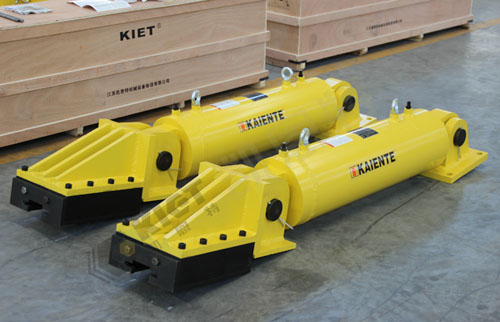
Synchronous Sliding Hydraulic Jack Operation Instructions:
1. Key points before equipment installation:
(1) Meet the requirements of the sliding driving force of the steel structure sliding unit, and try to make each hydraulic crawler evenly loaded.
(2) Try to ensure that the number of hydraulic crawlers driven by each pumping station is equal to improve the utilization rate of the pumping station.
(3) In the overall layout, the safety and reliability of the system should be carefully considered to reduce engineering risks.
2. Slip track layout
A total of 2 slip tracks are laid for sliding, and the slip track is set at the position of the corresponding concrete beam web in the assembly platform area. The position of the temporary bracket slide beam corresponds to the web of the steel box girder.
3. Arrangement of hydraulic crawler
The skid steer cylinder is equipped with a total of 2 sets of 60t-600mm cylinders.
3. Arrangement of hydraulic pumping station
The hydraulic pump station is arranged according to the type and number of hydraulic cylinders at each slip point, as well as the required slip speed. The layout of the hydraulic pumping station follows the following principles:
(1) The power provided by the pumping station should ensure sufficient sliding speed;
(2) Nearby arrangement to shorten the tubing pipeline;
(3) Improve the utilization efficiency of the pumping station.
According to the above principles, one pumping station is arranged on site, connected by oil pipes. The power of the oil pump is 7.5kw×2, and the on-site pumping station moves with the rail clamper, and the power supply is a three-phase four-wire system, and the cable needs to be long enough.
4. Layout of computer control system
Sensor arrangement:
(1) Pressure sensor: in each hydraulic cylinder, install 1 pressure sensor; The pressure sensor is mounted on the large cavity side of the cylinder.
(2) Cylinder stroke sensor: One stroke sensor is installed in each hydraulic cylinder to measure cylinder stroke and process cylinder pressure signals.
(3) Connect various sensors with their respective communication modules.
5. Connection of on-site real-time network control system
(1) Arrange a computer control cabinet on the ground, from which the communication line, solenoid valve communication line, cylinder signal communication line, and working power supply line are drawn.
(2) All pumping stations are networked through communication lines and solenoid valve communication lines.
(3) All cylinder signal communication modules are networked through the cylinder signal communication line.
(4) Connect all module power cables through power cables.
After the installation of the sensors and the connection of the on-site real-time network control system, the layout of the computer control system is completed.
6. Pre-slip system debugging:
After the synchronous slip hydraulic system connection is installed, follow the following steps for debugging:
(1) Check whether the joints of all valves or hard pipes on the pumping station are loose, and check whether the pressure regulating spring of the relief valve is completely relaxed.
(2) Check whether the cable connection between the pumping station starter cabinet and the hydraulic crawler is correct.
(3) Check whether the tubing connection between the pumping station and the hydraulic crawler main cylinder is correct.
(4) The system transmits power, and checks that the operation switch of the control cabinet of the pumping station is in a stopped state.
(5) Start the pumping station, check whether the rotation direction of the hydraulic pump spindle is correct, and stop starting correctly; If it is not correct, adjust the power lines opposite each other, send power after adjusting, and then start the pumping station, check whether the hydraulic pump spindle rotation direction is correct, and stop starting correctly.
(6) When the pumping station does not start, manually operate the corresponding buttons in the control cabinet to check whether the solenoid valve and the shut-off valve are operating normally, and whether the globe valve number and the creeper number correspond.
(7) Check the stroke sensor. Press the travel sensor of each hydraulic crawler to measure the wire rope and light up the corresponding signal light in the control cabinet.
(8) Check before jacking: start the pumping station, adjust a certain pressure (about 2Mpa), telescopic crawler cylinder: check whether the tubing connection of A cavity and cavity B is correct;
(9) Preloading: Adjust a certain pressure (2~3Mpa) to make the wedge clamp in basically the same locking state. The loading step is based on the crawler's initial pressurization to 40%, 60%, 80% of the required pressure, and can be increased to 100% when everything is stable. After there is a displacement at the beginning, pause. Comprehensively check the normal operation of each equipment: changes in the creeper clamping device, sliding track and truss stress. Under normal circumstances, the slide can officially begin.
7. Formal slip
(1) The pump source pressure value is set in advance according to the design jacking load, so as to control the maximum output thrust of the crawler and ensure the safety of the entire jacking facility.
(2) During the jacking process, the surveyor should measure the accurate value of the displacement of each jacking point through a long-distance sensor or steel tape measure.
(3) The computer control system feeds back the distance signal through the long-distance sensor to control the error of the two sets of crawlers within 2mm, so as to control the synchronous push of the whole truss.
(4) The crawler is a hydraulic system, and through flow control, the starting and stopping acceleration of the crawler is almost zero, and the impact force on the track is very small.
8. Synchronous pushing
The on-site network control system determines the current position of all hydraulic cylinders according to the synchronous sliding hydraulic jack stroke signal, and the main control computer determines the next action of the hydraulic cylinder based on the user's control requirements and the current status information of the hydraulic cylinder. When the main control computer decides the next action of the hydraulic cylinder, it issues action instructions to the hydraulic pump station to control the corresponding pumping station action, so as to achieve the consistent action of all hydraulic cylinders, and adjust the cylinder speed in real time according to the stroke information.
At the end of the article, I would like to recommend the configuration of our company's 2-point and 4-point synchronous push-up system: