


Hydraulic jacks are used in a wide range! Most of the time we use it as a lifting tool for heavy loads, such as jacking maintenance of large equipment, jacking adjustment of 10,000-ton presses, replacement of bridge jacking bearings, jacking of steel structures, etc. However, in some cases, we need its lateral movement ability, such as the horizontal movement of large steel structures, the overall movement of box culverts, underground pipe jacking construction, the movement of large generators in place, etc. But due to the different structures of various types of hydraulic jacks, when it needs to be used horizontally, what kind of hydraulic jack should we choose?
In order to figure out the principle of jacking of a hydraulic jack, let's first take a look at its internal structure.
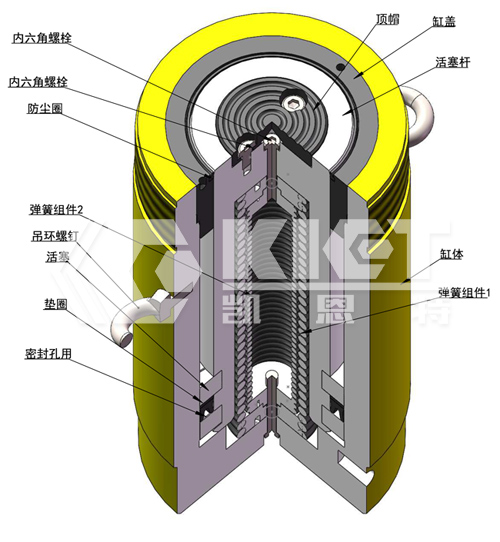
RC100 ton single-acting hydraulic jack internal structure
Through the diagram, we can clearly see that the inside of RC100 ton single-acting hydraulic jack is composed of socket bolts, top caps, cylinder heads, dust caps, piston rods, spring assemblies, pistons, washers, etc. When the piston rod is extended in longitudinal jacking, it is subjected to its own gravity, as well as lateral stress and friction around the piston and the tension of the spring assembly. Since the lateral stress can be ignored when used vertically, the friction between the piston rod and the internal components is small, and the direction of its own gravity and spring tension is the same, and the piston rod is easily reset.
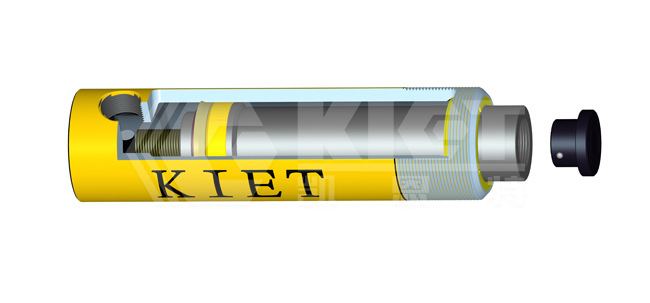
Hydraulic jacks are used for lateral movements
Through the above figure, we can see that the piston rod is mainly affected by hydraulic pressure, spring tension, the gravity of the piston rod itself, and the friction of the cylinder head and various rings. The hydraulic force is the only force of the piston rod ejection, and the rest is the resistance of the piston rod ejection. Because part of the gravity of the piston rod is in contact with the lower part of the dust ring gasket, the friction between the piston rod and the dust ring gasket is different on the circumference of contact.
Since the dead weight of the piston rod of different models of hydraulic jacks varies, ranging from a few kilograms to several hundred kilograms, the larger the dead weight is a test for the dust ring gasket, so we have no problem choosing a smaller tonnage jack in general transition applications. If it needs to be used in the transition application of large heavy objects such as large steel structures and large bridges, Cairn recommends a synchronous jacking hydraulic system specially used for jacking applications, and its cylinder block is supported by reinforcing components for moving applications, which can well cope with the loss of piston rods during the jacking process.

Synchronous jacking hydraulic jack
Finally, a large-tonnage synchronous jacking configuration scheme is recommended: four-point synchronous jacking system track transfer equipment configuration scheme