


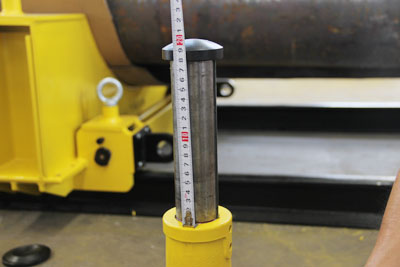
1. The selected jack tonnage should be greater than the weight of the jacked weight:
First of all, you must know the weight that needs to be lifted, and the load capacity of the hydraulic jack should be at least 1.2 times the weight. In addition, certain special jacking points should be noted, which may require a higher load-bearing capacity of hydraulic jacks.
2. Check the hydraulic system and accessories:
Before use, be sure to check whether each accessory is complete, and if it is damaged or missing, it must be replaced immediately.
3. Read the operation manual carefully:
Before use, be sure to read and understand the content of the operation manual in detail, and do not blindly start operating.
When operating hydraulic tools, be sure to wear protective equipment such as goggles, safety gloves, work clothes, etc.
4. Check all the jack bottoms, be sure to make sure they are fully supported:
All jacks or hydraulic systems must be supported by a strong base that does not slip at the bottom.
5. When the plunger of the jack is fully retracted, hydraulic oil can be added:
The hydraulic oil of the pump body must be added only when the plunger is fully retracted, and it should not exceed the recommended maximum capacity.
6. The center of gravity of the weight is aligned with the center line of the jack:
The weight must be lifted to the center line of the jack or evenly distributed by multiple jacks. In the case of partial load, it is easy to cause objects to slip and weaken the bearing capacity.
7. When using multiple jacks at the same time, the counterweight must be even:
When using multiple jacks, it is necessary to confirm the required lifting point and the number of jacks to ensure an even distribution of the load.
8. After the object is jacked into place, please fix the support:
After the object is jacked into place, please put the cushion under the heavy object and put the fixed support; As the height increases, please also increase the height of the fixed support, and at the same time, in the space of the fixed support, it is necessary to clear all people and other objects, paying special attention to hands or other parts, and not between the object being carried and the fixed support. The jack is not intended as a permanent support, and if you need to support the carrier for a period of time, be sure to use a fixed support or use a self-locking jack.
9. Hydraulic connection:
When connecting all hydraulic system components, it is important to ensure that the manometer, joints, etc. links are in order. Threaded connections must be tightly threaded and do not leak oil. At the same time, do not over-tighten the connections with external force, which may cause damage to the joints or screws.
10. Avoid heat source and welding sparks:
The sparks generated during welding will cause damage to the seals and oil pipes of the jack. At the same time, high heat may also cause hydraulic oil evaporation and explosion.
11. Hydraulic disconnection:
When the hydraulic system is in the load-bearing situation, it is absolutely impossible to try to disconnect the hydraulic system, the jack must be unloaded first, and then the oil return device of the pumping station must be opened several times, and the pressure in the system has been confirmed, and it is indeed removed. If there is a connected pressure gauge in the system, be sure to check the pressure gauge again and the pressure in the system has been completely removed.
12. It is forbidden to drag the pump body with oil pipes:
When moving the system of the connected cylinder and pump, do not drag the tubing, as this will cause damage to the connection and make it more dangerous.
13. Non-bendable oil pipe:
Do not bend the oil pipe, or place heavy or sharp objects on the oil pipe, and keep the oil pipe away from the area where vehicles are frequent.
You may also want to know: Precautions for using hydraulic jacks