


Analysis of the causes of tilt in house jacking correction
There are many reasons for uneven settlement or tilt of houses, the main ones are as follows:
1. Design reasons
Due to the lack of understanding of the importance of foundation problems, complex foundation problems are often simplified. According to the statistics of accidents in foundation engineering by relevant departments, about 33% of the total number of quality problems occurred in building foundations due to design reasons.
1. When designing the foundation of the building, the characteristics of the foundation soil are not grasped, and there is a lack of scheme comparison and expert demonstration, resulting in accidents due to improper foundation form.
2. On the deep silt soft foundation, the wrong selection of immersed pipe cast-in piles, immersed pipe ramming and expansion piles and other foundation forms often occur.
3. On foundations of uneven thickness such as fill soil, soft soil or collapsible loess, foundation schemes such as strips or rafts are used, resulting in the tilt of the building.
4. For under-consolidated soft soil foundations such as fill and silt, a large amount of backfill and stacking on the ground, when adopting the pile foundation scheme, the effect of friction is ignored in the calculation, and the number of piles is often insufficient, resulting in accidents such as excessive settlement of the pile foundation and broken piles, resulting in cracking or tilting of the building.
5. Two or more foundation forms or foundations are placed on the foundation soil layer with different stiffness on the same building, which is prone to tilting.
6. For soft soil foundations or buildings with complex shapes and large height changes, they must be designed according to the conditions of dual control of deformation and strength to ensure the overall uniform settlement of the building. If only strength is checked, it will lead to uneven settlement of the building.
7. Insufficient grasp of current national norms and relevant technical standards. Moreover, there are dozens of technical standards related to foundations, the content is very complex, and the specifications are constantly revised and updated, and the inappropriate design methods are adopted due to the lack of correct understanding of the specifications.
8. When designing the foundation of a high-rise building, the total load of the building does not pass through the center of the foundation area, and the eccentric moment of the load is too large, so that the stress distribution of the base is uneven, and it is easy to cause serious tilt or damage to the building. The calculation is not carried out according to the dual control requirements of deformation and strength, resulting in serious consequences.
9. When considering the joint work of pile and soil, the load ratio of soil between piles is too large, and the number of piles is small, resulting in excessive settlement or tilt of the house.
10. The prefabricated pile foundation is too dense, causing the ground to bulge, the product pile effect, etc., the pile cannot be driven, a large number of piles are cut, and the pile tips of some pile foundations do not reach the bearing layer, so that the pile foundation will settle unevenly, and the building will tilt or crack.
11. Ignoring the superposition effect of base stress of adjacent new and old buildings, causing new additional settlement or different elevations of new and old buildings, and not taking relevant measures. The fill layer around the deep foundation building is neglected during the design, resulting in the tilt of the building.
12. Backfill the foundation, throw a large number of stones and abandoned building garbage when filling the soil, the shape and size are different, resulting in the material composition of the foundation soil is extremely uneven, this factor is not considered in the design, when using strip foundation and raft, local stress concentration occurs, resulting in foundation cracking or tilting.
13. When carrying out the renovation or expansion of existing buildings, the foundation of the new project is pressed on the foundation of the original building, resulting in serious consequences.
14. When carrying out the renovation of existing buildings, the bearing capacity of the foundation of existing buildings is overestimated and the value is improper.
15. The residential area is planned on soft soil foundations such as underconsolidated deep silt, resulting in a large area of subsidence of the entire residential area or the tilting of some buildings.
2. Construction reasons
When constructing foundations, quality accidents occur in building foundations due to failure to strictly follow the construction drawings accounting for about 55% of the total number of accidents.
1. Poor construction quality of foundation engineering: the construction unit cuts corners, falsifies, the pile length does not meet the design requirements, reduces the reinforcement arbitrarily, reduces the strength level of concrete, uses inferior quality just to reduce the size of the foundation and reduce the deep burial of the foundation, and inaccurate laying of the foundation construction.
2. Reasons for foundation treatment: At present, there are many methods of foundation treatment, and there are many problems in this regard, such as the pile end does not enter the design bearing layer; the pile diameter does not meet the design requirements; the strong compaction has not reached the effective depth of influence; vibrating crushed stone piles have not achieved the densification effect; the detection methods are unreasonable or fail to accurately reflect the actual situation, etc.
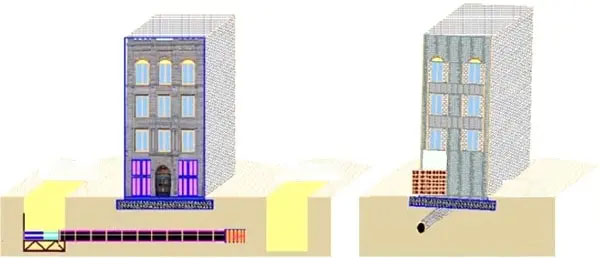
3. Cracking of ground buildings caused by underground excavation: The city causes ground subsidence due to the construction of underground buildings such as subways and underground streets, or the excavation of mining and coal mining roadways in mining areas, resulting in sinking, cracking, tilting and other damage to ground buildings.
4. Damage to buildings caused by the construction of adjacent deep foundation pits: In the construction of foundation engineering of high-rise buildings, due to the excavation, support, precipitation, water stop, soil instability of deep foundation pits, the collapse of the ground around the foundation pit, and the interaction of the construction of foundation engineering of adjacent buildings, it will cause threats and damage to adjacent buildings that have been built or are under construction, causing serious accidents.
Analysis of the causes of tilt in house jacking correction
3. Reasons for engineering survey
Due to the failure to meet the survey requirements during the foundation survey, the quality accidents of the building foundation account for about 10% of the total number of accidents.
1. The survey points are arranged too little, or only the geological data of adjacent buildings are drawn from, and the building site is not carefully surveyed and evaluated, and the address survey report cannot truly reflect the site conditions, such as dark rivers, slopes, karst caves, tombs and old civil air defense underpasses, etc., resulting in serious subsidence, tilt or cracking of newly built buildings.
2. Inaccurate survey data, incorrect conclusions, and unreasonable suggestions mislead structural designers. Exploration analysis of soils prone to liquefaction or creeping is neglected.
4. Other reasons
In addition to some of the above reasons, such as collapsible loess foundation, collapsibility caused by water immersion, etc.; or the soil swelling, frost heave and collapse of the liquefied foundation due to earthquake liquefaction, etc., which are easy to tilt the superstructure.
1. The influence of surrounding construction excavation, precipitation, stacking, vibration and other factors.
2. Natural rise and fall of groundwater level: More than 360 cities in our country have serious water shortages, due to a large number of over-limit mining and pumping of groundwater, the groundwater level drops significantly, or due to the construction of reservoirs and other reasons, causing the upper body of the groundwater table, which will change the bearing characteristics of the foundation of the building and may cause the sinking or tilt of the building.
3. When groundwater is erosive, or there are corrosive substances on the concrete foundation around, the foundation concrete and steel bars will be seriously corroded, causing serious cracking of the foundation and causing the building to tilt.
4. Improper use of completed buildings: such as long-term water and sewage pipe rupture, long-term water accumulation on the ground, blockage of sewage wells, sewage flowing into the foundation, etc., may cause the foundation to be flooded and collapsed.
5. During decoration, the load-bearing wall is arbitrarily demolished, causing the bearing structure to crack or tilt.
6. In addition to the above human factors, natural disasters such as earthquakes, landslides, floods, mudslides, etc. cause liquefaction of the foundation, hollowing out of the foundation soil by water, foundation slippage, etc., which will cause serious damage to the building.
The specific jacking and correction process We will explain in this article:the jacking process of PLC synchronous jacking system in high-rise building correction