


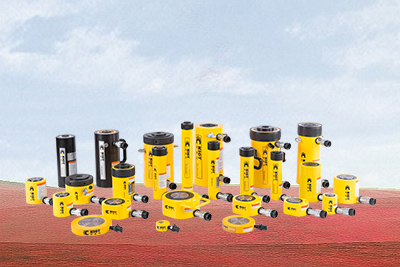
A hydraulic jack is driven by a hydraulic power unit, which injects hydraulic oil into the cylinder body, causing a change in volume and driving the piston outwards. For a detailed explanation of the working principle, please refer to our related article "Working Principle of Ultra-Thin Jacks" on this site. Here, we'll focus on the essential parameters of a hydraulic jack: tonnage, collapsed height, and stroke. Below, we'll explain how to determine these parameters.
I. Selecting the Right Tonnage
How much tonnage do you need for your jack? After accounting for resistance loss from seals and support resistance loss between the jack and piston, a jack's actual force is typically 94% to 95% of its rated capacity. For continuous, rigorous operation, it's recommended to choose a jack with a higher tonnage than your load, usually calculated at 70% to 80% of the maximum load. This ensures safe operation and extends the jack's service life.
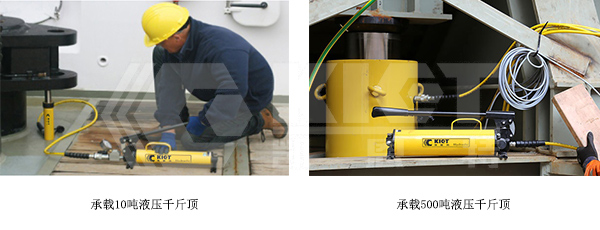
For maintenance or lifting small objects, a 5-50T hydraulic jack is usually sufficient.
For lifting large, heavy objects or large steel structures, choose 200T-2000T high-tonnage hydraulic jacks.
II. Choosing the Stroke Length
Stroke refers to the length the jack's piston can extend. If installation space allows, select a jack with a stroke longer than your actual requirement to improve system scalability.
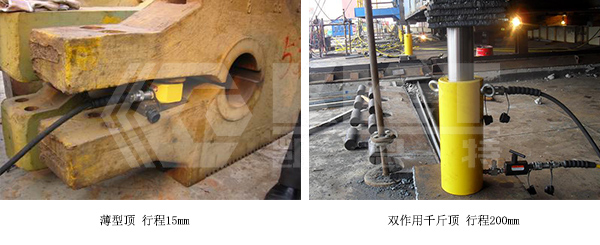
For single lifts of only a few millimeters, a thin-type jack is suitable.
For single lifts requiring 20 cm or more, choose a split-type, long-stroke jack.
III. Considering Collapsed Height
Collapsed height is a critical factor when the jack's operating environment has space constraints. In such cases, the jack's collapsed height must not exceed the available space. For example, in bridge repair construction, where there's only a narrow gap between the bridge and the pier, the requirement for the jack's collapsed height is stringent, necessitating careful selection.
IV. Selecting the Jack Type
Hydraulic jacks generally fall into two categories: single-acting jacks (spring return or load return) and double-acting jacks (which can both lift and pull back using hydraulic pressure). Ultra-low, thin hydraulic jacks do not have a spring mechanism and can only retract through load or gravity. Consider what work the jack needs to do: lifting, pulling, or both.
Hollow piston jacks have a central bore that allows steel cables or rods to pass through.
If the jack needs to maintain a load for an extended period after lifting, choose a threaded self-locking jack.
V. Determining the Quantity of Jacks
When lifting large, heavy objects, jacks should be placed at the object's center of gravity to ensure a balanced load. For safer lifting, it's common to operate multiple jacks simultaneously, positioning them evenly across the load-bearing surface. The same principle applies to pushing operations.
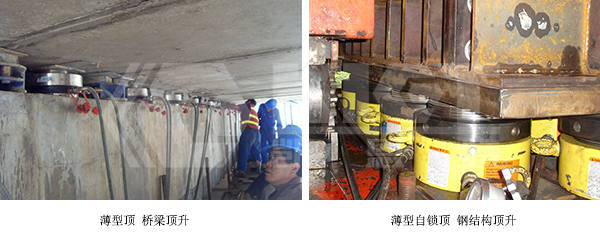
Large objects or long-span steel structures may require dozens, or even hundreds, of jacks operating simultaneously to achieve the desired outcome.
VI. Non-Standard and Special Hydraulic Jacks
If the jack models and parameters provided on our website do not meet your requirements, or if your application demands a specialized jack, we can custom-manufacture non-standard hydraulic jacks according to your specifications. Examples of special requirements include:
Tonnage exceeding 500 tons, beyond standard jack capacities.
Special requirements for stroke or collapsed height.
Need for threads on the piston, cylinder body, or base of the jack.
If fixed-position work is required, mounting holes can be provided at the bottom or top of the jack's piston; if frequent carrying or transport is needed, handles can be installed.
Special operating frequencies or conditions requiring high-temperature, low-temperature, or corrosion resistance.
Jacks requiring a limit switch when the stroke reaches its maximum.
Jacks operating with eccentric loads may require an anti-eccentric saddle installed on top of the piston.
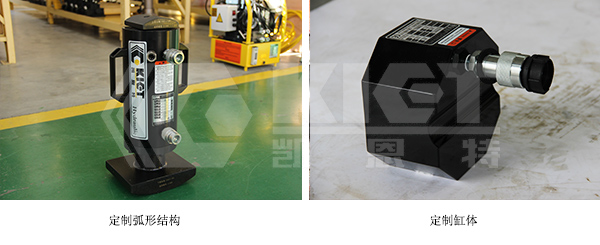
KIET can customize non-standard hydraulic jacks according to customer needs.
For more detailed information on specific types of hydraulic jacks and their actual appearances, please refer to our article:《Understanding Hydraulic Jacks》